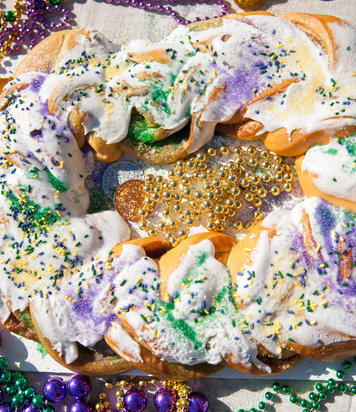
Traditional King Cake Recipe
Sometimes it's best not to mess with success. Try this recipe for a traditional king cake, packed with flavor, heritage and a whole lot of Louisiana pride.

Ready to bake up Louisiana's sweetest Mardi Gras tradition? Dive into this classic recipe perfected by New Orleans Chef John Besh.
Whether you're an expert baker or a novice in the kitchen, you're sure to be successful with these step-by-step instructions and answers to commonly asked questions.
Ingredients for King Cake
-
1 cup lukewarm milk (about 110 degrees)
-
½ cup granulated sugar
-
2 tablespoons dry yeast
-
3 ¾ cups all-purpose flour
-
1 cup melted butter
-
5 egg yolks, beaten
-
1 teaspoon vanilla extract
-
1 teaspoon grated fresh lemon zest
-
3 teaspoons cinnamon
-
Several gratings of fresh nutmeg
Ingredients for King Cake Icing
-
2 cups powdered sugar
-
¼ cup condensed milk
-
1 teaspoon fresh lemon juice
-
Purple, green and gold sugar crystals
-
1 fève (fava bean) or plastic baby to hide in the cake after baking
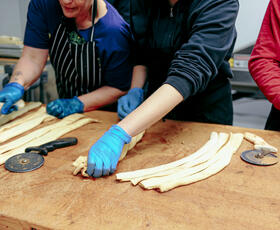
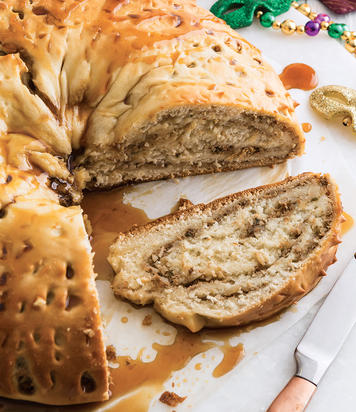
To shape king cake, braid the dough.
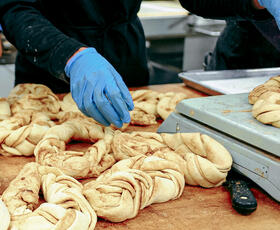
Then shape the braids into a circle to represent a crown.
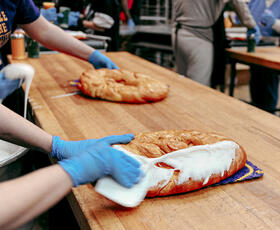
Once baked and cooled, coat the cake in icing.
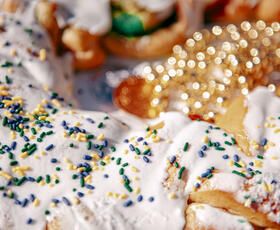
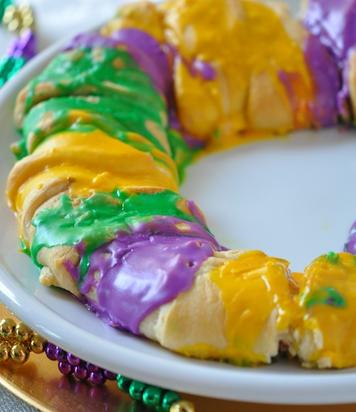
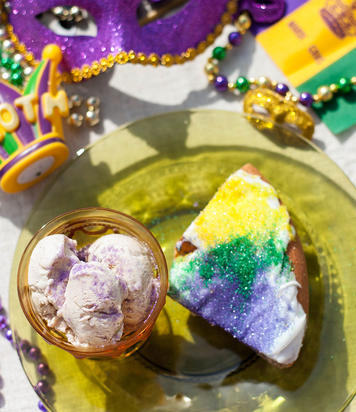
Finally, top the cake with sprinkles in Mardi Gras colors.
Step-by-Step Instructions for King Cake
- For the cake, pour the warm milk into a large bowl.
- Whisk in the granulated sugar, yeast and a heaping tablespoon of the flour, mixing until both the sugar and the yeast have dissolved.
- Once bubbles have developed on the surface of the milk and it begins to foam, whisk in the butter, eggs, vanilla and lemon zest.
- Add the remaining flour, cinnamon and nutmeg, and fold the dry ingredients into the wet ingredients with a large rubber spatula.
- After the dough comes together, pulling away from the sides of the bowl, shape it into a large ball.
- Knead the dough on a floured surface until it is smooth and elastic, about 15 minutes.
- Put the dough back into the bowl, cover with plastic wrap and set aside in a draft-free place to let it proof, or rise, for 1 1/2 hours or until the dough has doubled in volume.
- Preheat the oven to 375 degrees.
- Once the dough has risen, punch it down and divide the dough into three equal pieces. Roll each piece of dough between your palms into a long strip, making three ropes of equal length. Braid the ropes around one another and form the braided loaf into a circle, pinching ends together to seal.
- Gently lay the dough on a nonstick cookie sheet and let it rise until it doubles in size, about 30 minutes.
- Once it's doubled in size, place the cookie sheet in the oven and bake until the braid is golden-brown, about 30 minutes.
- Remove the cake from the oven, place on a wire rack, and allow to cool for 30 minutes.
Step-by-Step Instructions for King Cake Icing
- While the cake is cooling, whisk together the powdered sugar, condensed milk and lemon juice in a bowl until the icing is smooth and spreadable. If the icing is too thick, add a bit more condensed milk; if it's too loose, add a little more powdered sugar.
- Once the cake has cooled, spread the icing over the top of the cake and sprinkle with purple, green and gold sugar crystals while the icing is still wet.
- Tuck the fève or plastic baby into the underside of the cake and, using a spatula, slide the cake onto a platter.
Frequently Asked Questions About King Cake
What is Carnival, Mardi Gras and Twelfth Night?
Carnival refers to the entire season of Mardi Gras celebrations, which end on Mardi Gras Day (also known as "Fat Tuesday"). Every year, Carnival kicks off on January 6. Some faith traditions call this day the Feast of Epiphany, while those who celebrate Carnival know it as Twelfth Night. The best way to honor this tradition? By having a slice of king cake, of course!
How did king cake become part of the Mardi Gras celebration?
Tribes marked winter’s end with a crown-shaped cake, hiding a bean or nut inside. The Romans later chose festival kings through a lottery system, a custom the Catholic Church associated with the Epiphany by the 4th century. By the 17th century, the "King of the Bean" was popular in European culture, and French settlers introduced this tradition to New Orleans, where it thrived. Today, traditional king cake is a braided, oval-shaped brioche swirled with cinnamon and topped with purple, gold and green sugar (though there are many creative variations!). A small plastic baby tucked into the cake symbolizes good luck, and the finder either buys the next king cake or hosts the next party.
How is the baby added to the cake? Can I bake the baby into the cake?
Plastic babies are inserted after baking to prevent melting and the release of harmful chemicals. Often bakeries will leave the baby out, packaging it separately for customers to insert themselves. If you're adding a baby yourself, you can tuck it into the bottom of the cake or slip it into a pre-cut slice.
Where can I find king cake?
During Carnival in Louisiana, you can find both traditional king cakes and creative riffs on the classic at most bakeries and grocery stores. For specialty cakes, check out Haydel’s Bakery in New Orleans or at Cajun Market Donut Company in Lafayette. Or make your own!
Discover more recipes and immerse yourself in Louisiana's Food Culture. For more insights into Louisiana cuisine, culinary experiences and travel inspiration, sign up for our eNewsletter and stay connected to the flavors of Louisiana.